Ethereum Whale Exits 11,106 ETH Stake, But $25 Million Loss Raises Questions
영어 원문번역 보기
글자 크기본문 읽기 ↓
이미지 불러오는 중
Key takeaways An Ethereum whale reportedly withdrew 11,106 ETH from staking after originally staking 10,117 ETH, a gain of 989 ETH (about 9.8%). Valued at the reported entry price of $4,277 and exit price of $1,645, the position fell from about $43.27 million to $18.27 million. ETH never traded near $4,277 in 2022, so the reported entry price does not fit a stake opened in late 2022. The $25 million figure should not be treated as a verified realized loss without the wallet and transaction history. Staking rewards are paid in ETH, so they add tokens but do not protect a position from a falling ETH price. An Ethereum whale has reportedly withdrawn 11,106 ETH from staking, prompting estimates of a $25 million loss despite an increase in the n…
Reason to trust

Strict editorial policy that focuses on accuracy, relevance, and impartiality
Morbi pretium leo et nisl aliquam mollis. Quisque arcu lorem, ultricies quis pellentesque nec, ullamcorper eu odio.
• An Ethereum whale reportedly withdrew 11,106 ETH from staking after originally staking 10,117 ETH, a gain of 989 ETH (about 9.8%).
• Valued at the reported entry price of $4,277 and exit price of $1,645, the position fell from about $43.27 million to $18.27 million.
• ETH never traded near $4,277 in 2022, so the reported entry price does not fit a stake opened in late 2022.
• The $25 million figure should not be treated as a verified realized loss without the wallet and transaction history.
• Staking rewards are paid in ETH, so they add tokens but do not protect a position from a falling ETH price.
An Ethereum whale has reportedly withdrawn 11,106 ETH from staking, prompting estimates of a $25 million loss despite an increase in the number of tokens held.
The figures, attributed to on-chain analyst Ember by reports published on Sunday, suggest the investor originally committed 10,117 ETH to staking before redeeming a considerably larger balance.
However, a discrepancy between the reported entry price and Ethereum’s historical trading data leaves questions over the actual duration and profitability of the investment.
Ethereum Whale Adds 989 ETH To Its Holdings
According to the reports, the initial 10,117 ETH position was valued at approximately $43.27 million using an Ethereum price of $4,277.
The reported redemption of 11,106 ETH represents an increase of 989 tokens, or approximately 9.8%.
Using the reported exit valuation of $1,645 per ETH, those holdings would be worth roughly $18.27 million, around $25 million below the stated initial valuation.
The whale’s reported staking position, using the figures attributed to on-chain analyst Ember. The entry price and timing have not been independently verified. Data: Ember, via EconoTimes. Visualization: NewsBTC.
The arithmetic checks out. The historical timeline does not.
CoinGecko’s 2022 Annual Crypto Industry Report puts Ethereum’s highest price that year at approximately $3,835, with ETH ending December near $1,199.
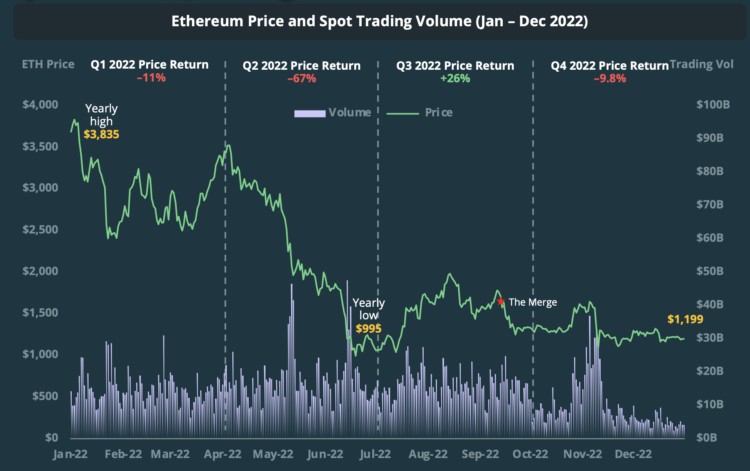
Ethereum’s price performance and spot trading volume throughout 2022. ETH reached a yearly high of $3,835 before closing the year near $1,199. Source: CoinGecko.
That makes the reported entry price of $4,277 inconsistent with a staking position opened four years ago, in late 2022, assuming the figure represents ETH’s market price at the time.
It is possible the quoted price refers to an earlier acquisition rather than the staking deposit itself. Without the original wallet address and transaction history, however, the distinction cannot be resolved.
The reported $25 million difference should therefore not be treated as a verified realized trading loss.
Why Ethereum Staking Rewards Cannot Eliminate Price Risk
Even with the uncertainty surrounding this particular transaction, the reported figures illustrate an important risk for Ethereum investors.
Staking rewards are typically earned in ETH rather than US dollars. An investor can accumulate more tokens while the dollar value of the overall position declines.
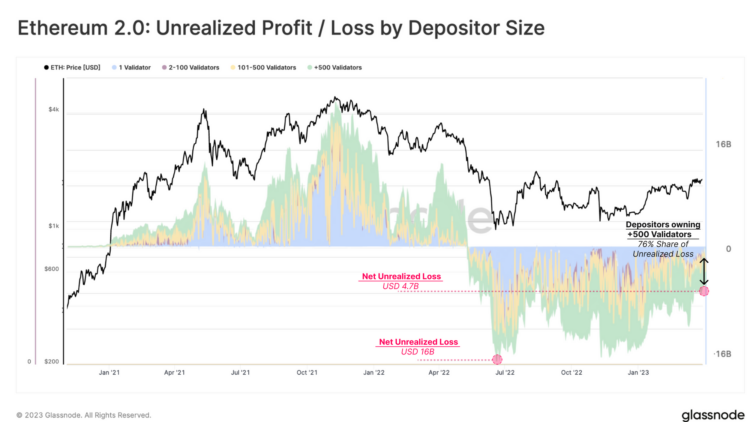
Historical unrealized profits and losses among Ethereum staking participants, with depositors operating more than 500 validators accounting for 76% of unrealized losses at the time of the April 2023 assessment. Source: Glassnode.
Using the reported balances and valuations, the additional 989 ETH would be worth approximately $1.63 million at $1,645 per token.
The final balance of 11,106 ETH would need to trade near $3,896 per token to recover the stated initial valuation of $43.27 million, excluding fees, taxes and any additional transactions.
The example also highlights why rising Ethereum staking does not necessarily translate into higher ETH prices.
Staking can improve returns relative to holding the same asset without earning rewards. It does not remove exposure to the asset’s underlying price.
Does Unstaking Mean More Selling Pressure For ETH?
Ethereum’s withdrawal mechanism allows validators to recover eligible rewards or withdraw their remaining stake following an exit.
Neither action automatically constitutes a sale. An investor may transfer the funds into another wallet, move to a different staking provider or retain the tokens without staking them again.
The broader staking market also presents a different picture from individual whale withdrawals. Data from Bitwise and Allium shows that Ethereum recorded net staking inflows of 1.99 million ETH in the third quarter of 2026, following 1.44 million ETH in the previous quarter. Individual exits can therefore occur even as the network continues to attract additional staking capital.
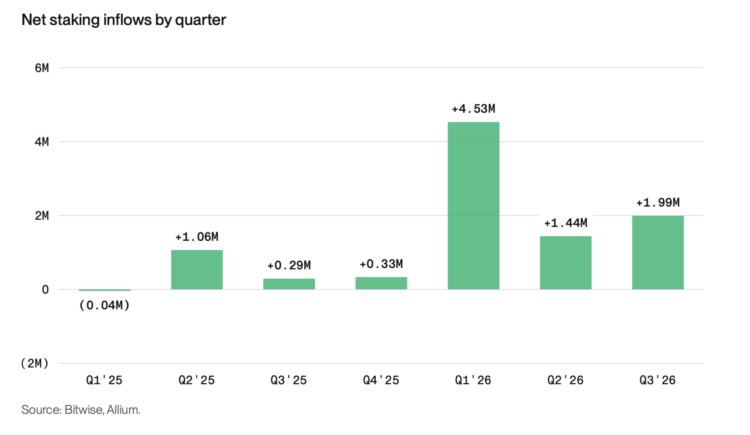
Ethereum recorded net staking inflows of 1.99 million ETH in Q3 2026, following 1.44 million ETH in Q2 and 4.53 million ETH in Q1. Source: Bitwise and Allium.
Although Sunday’s reports describe a sale, the original transactions and execution prices have not been independently established.
Until those details become available, the transaction cannot reliably be used as evidence of broader whale capitulation or a new wave of Ethereum selling.
For traders, the distinction between unstaking and selling matters as much as the size of the position itself.