Bitcoin Money Printing: Pompliano Predicts Gains
英文原文查看译文
阅读字号阅读正文 ↓
加载图片中
Bitcoin money printing concerns are back in focus after prominent investor Anthony Pompliano shared a bold prediction about the cryptocurrency’s long-term future. According to Pompliano, continued government monetary expansion could provide a powerful reason for Bitcoin to appreciate over time, regardless of temporary market corrections. The investor’s latest comments arrive as Bitcoin experiences another period […]

Bitcoin money printing concerns are back in focus after prominent investor Anthony Pompliano shared a bold prediction about the cryptocurrency’s long-term future. According to Pompliano, continued government monetary expansion could provide a powerful reason for Bitcoin to appreciate over time, regardless of temporary market corrections.
The investor’s latest comments arrive as Bitcoin experiences another period of volatility, raising questions about whether short-term price movements accurately reflect the cryptocurrency’s long-term potential.
While traders continue monitoring technical indicators and market sentiment, Pompliano believes a much bigger economic trend could ultimately determine where Bitcoin heads next.
Anthony Pompliano Makes Bold Bitcoin Prediction
On November 8, Pompliano, founder of Professional Capital Management and a longtime Bitcoin advocate, shared a new post on X explaining why he remains optimistic about the cryptocurrency.
His message was straightforward:
“Bitcoin will never stop going up, because the government will never stop printing money.”
The statement accompanied a discussion with Graham Stephan and Jack Selby covering Bitcoin, artificial intelligence, inflation, and investment opportunities over the next decade.

Pompliano’s argument centers on the difference between Bitcoin and traditional government-issued currencies.
Unlike the US dollar, which operates within a monetary system managed by the Federal Reserve, Bitcoin follows a predetermined issuance schedule with a maximum supply of approximately 21 million coins.
This means that increasing demand cannot simply be met by creating additional Bitcoin beyond the network’s established supply rules.
As a result, supporters believe Bitcoin could become increasingly attractive when investors are concerned about the long-term purchasing power of traditional currencies.
The relationship between monetary expansion and Bitcoin has already attracted considerable attention.
As Bitcoinist previously reported, global liquidity reached record levels earlier this year, even as Bitcoin’s price temporarily diverged from historical money-supply trends.
That divergence raises an interesting possibility: Bitcoin may not immediately respond to expanding liquidity, but the longer-term relationship remains an important factor for investors to monitor.
Why Bitcoin’s Limited Supply Matters
One of Bitcoin’s most distinctive characteristics is its predictable monetary policy.
New BTC enters circulation through mining rewards, which are reduced approximately every four years through an event known as the halving.
These reductions gradually slow the creation of new coins, making Bitcoin’s issuance increasingly scarce over time.
When governments and central banks expand the supply of traditional currencies, investors may seek assets that cannot be diluted in the same way.
Bitcoin, gold, and other scarce assets frequently enter that conversation.
However, Bitcoin also offers characteristics that distinguish it from physical commodities, including digital transferability, transparent issuance, and global accessibility.
Previous Bitcoinist coverage has examined how Bitcoin scarcity could support its appeal as an alternative financial asset.
Although limited supply alone cannot guarantee rising prices, growing demand combined with predictable issuance could create favorable long-term conditions.
Could More Liquidity Trigger Another Bitcoin Rally?
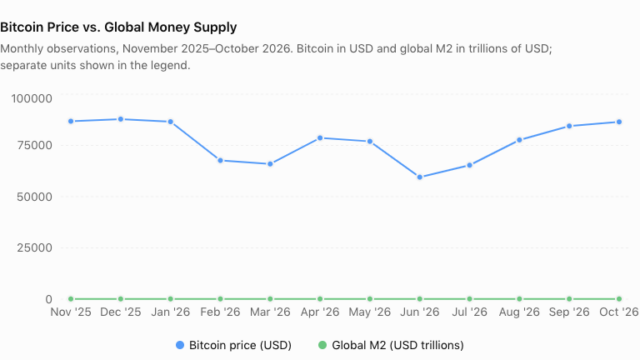
Bitcoin price and global money supply trends highlight the debate over whether expanding liquidity could support BTC’s long-term growth.
Pompliano’s latest statement also highlights a broader debate about how financial liquidity influences cryptocurrency markets.
When monetary conditions become more accommodative, borrowing costs may decline and investors may become more willing to allocate capital toward assets with greater growth potential.
Bitcoin has historically benefited during some periods of expanding global liquidity, although the relationship has not always been consistent.
Earlier this year, Bitcoinist highlighted an analyst’s interpretation of the Bitcoin M2 relationship, suggesting that changes in global money supply can influence Bitcoin’s market behavior over time.
The challenge for investors is determining when expanding liquidity will translate into stronger demand.
Money-supply growth does not automatically mean that capital will immediately flow into Bitcoin.
Interest rates, inflation expectations, institutional investment activity, and broader economic uncertainty can all influence the cryptocurrency’s performance.
Nevertheless, Pompliano’s argument suggests that investors should consider Bitcoin’s long-term monetary characteristics rather than focusing exclusively on daily price movements.
Bitcoin’s Long-Term Outlook Remains Promising
Bitcoin recently experienced renewed selling pressure, with prices briefly falling below $74,000 during November 8 trading.
However, temporary market corrections do not necessarily undermine the long-term investment thesis surrounding its fixed supply.
For Pompliano, the central question is not whether Bitcoin will experience volatility, but whether governments will continue pursuing monetary policies that expand the supply of traditional currencies.
If monetary expansion persists while Bitcoin adoption continues growing, the cryptocurrency could become increasingly attractive to investors seeking scarce digital assets.
His prediction is not a guarantee of uninterrupted price appreciation, and Bitcoin remains sensitive to changes in demand and global financial conditions.
Still, the underlying argument is significant.
As governments continue managing increasingly complex economic challenges, Bitcoin’s predictable supply may remain one of its strongest long-term advantages, potentially supporting renewed interest and future price growth.